
The Financial Machine Sustained by Power, Semiconductors, Networks, Exchange APIs, Keys, and Monitoring
The cloud is not a place where physical reality disappears.
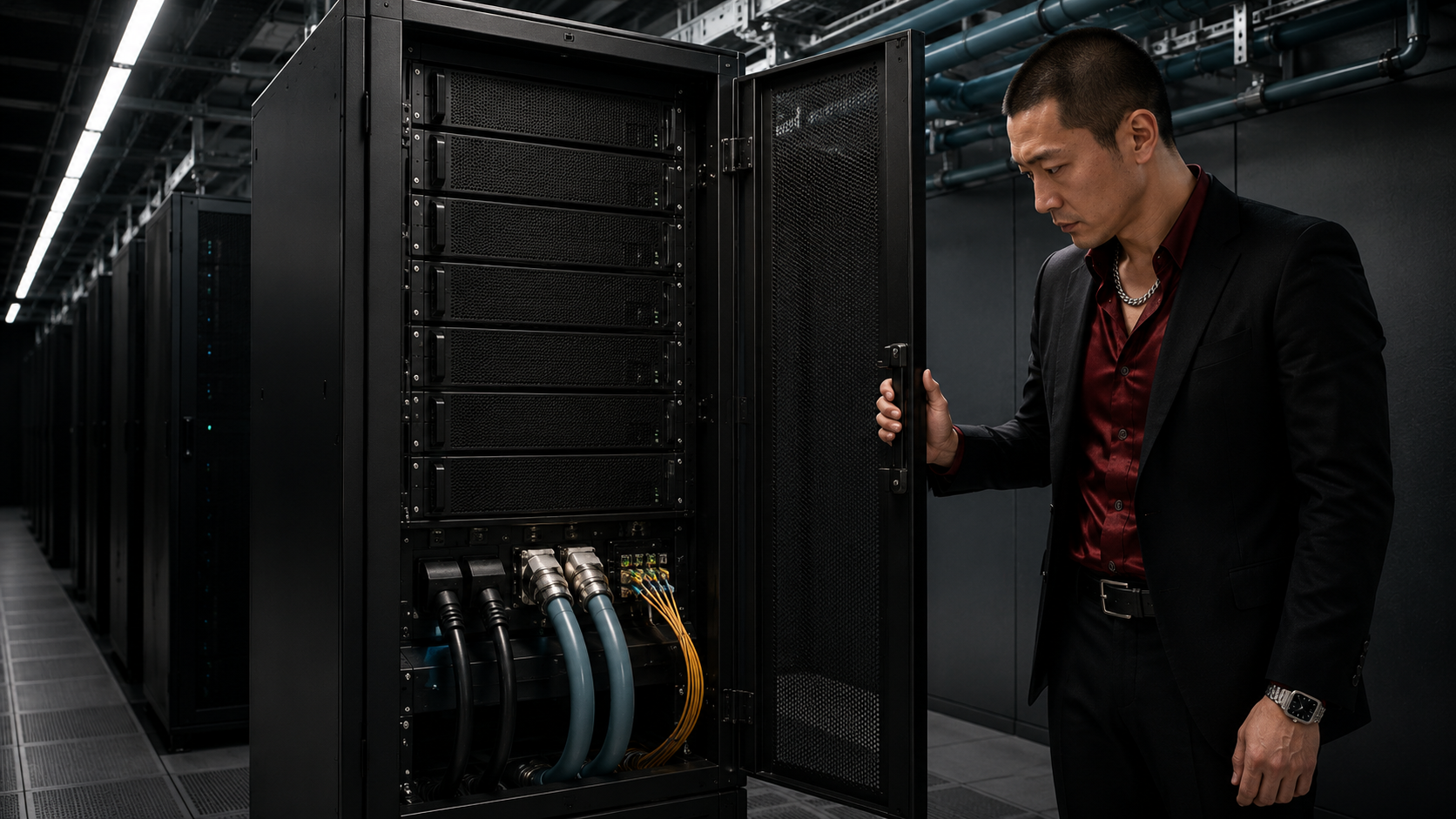
There are power plants supplying electricity, transmission lines carrying it, substations transforming it, cooling systems removing heat, and servers filled with semiconductors. Fiber-optic cables extend from the buildings that house them. The physical machinery still exists. Its owners, locations, and points of failure have simply moved farther from the user’s field of view.
Discussions of financial AI tend to focus on model accuracy, training data, inference capabilities, and order-execution algorithms. Yet a financial AI system connected to an actual market cannot operate on models and code alone.
It must receive prices, record timestamps, make decisions, submit orders, confirm executions, reconcile balances, preserve logs, detect anomalies, stop when necessary, and recover after failures. Every stage depends on a chain of electricity, cooling, semiconductors, computing resources, communications infrastructure, authentication systems, exchanges, custody arrangements, identity verification, monitoring services, backups, legal jurisdictions, and third-party contracts.
Financial AI is not an intelligence floating above the cloud.
It is a financial machine that can reach the market only because a large collection of external infrastructure allows it to do so.
The Physical Floor Beneath Intelligence
The International Energy Agency projects that global electricity consumption by data centers could rise from approximately 415 terawatt-hours in 2024 to approximately 945 terawatt-hours by 2030, with AI accounting for a major share of the increase. At the same time, grid connection queues, shortages of transformers and cables, and the long construction periods required for new generation and transmission capacity are becoming physical constraints on data center expansion. (IEA)
Computing resources do not emerge from a single manufacturer’s GPU. Semiconductor production depends on design, manufacturing equipment, specialized materials, wafers, front-end fabrication, memory, advanced packaging, assembly, and testing. These stages repeatedly cross corporate and national borders. The OECD describes the semiconductor value chain as globally distributed while also being highly concentrated at particular stages and around certain critical inputs. (OECD)
Financial supervision has also begun to change. In the European Union, certain third parties that provide essential information and communications technology services to financial institutions have entered direct oversight because of their potential impact on the operational continuity of the financial system. Their importance is evaluated not merely by company size, but by how many critical financial functions they support, how difficult they are to replace, and how widely a disruption could propagate. (ESMA)
The point is not to evaluate any particular utility, semiconductor company, cloud provider, or exchange.
The important development is that the facilities, supply chains, contracts, and jurisdictions beneath financial AI are no longer being treated as background conditions. They are increasingly recognized as components of financial-system availability itself.
Looking at Financial AI from the Bottom Up
The structure of financial AI is easier to understand when it is built upward from physical infrastructure rather than traced downward from the model.
Electricity, cooling, water, and buildings ↓Semiconductors, servers, memory, storage, and networking hardware ↓Local systems, on-premises infrastructure, cloud services,virtualization, and containers ↓Fixed and mobile networks, internet exchanges, BGP, DNS,TLS, NTP, and PTP ↓Price feeds, news, on-chain information, and exchange feeds ↓Exchange APIs, broker APIs, wallets, custodians, and KYC systems ↓IAM, API keys, private keys, KMS, HSM, MPC, and order permissions ↓Metrics, logs, traces, alerts, and balance reconciliation ↓Backups, failover, manual recovery, contracts, and jurisdictions
When the lowest layer fails, every layer above it becomes unavailable.
Without power, the system cannot compute. Without cooling, machines shut themselves down to prevent physical damage. Without communications infrastructure, the system cannot observe the market. Without DNS, it may be unable to locate the service it needs to contact. Without synchronized time, it cannot reliably establish the sequence of orders, executions, and logs.
If the exchange API fails, the system cannot submit orders. If authentication fails, it cannot access the API. If KYC review places an account on hold, the account may become unusable. If a private key is lost, assets may become immovable. If monitoring fails, the operator may not know that the system has stopped. If backups are defective, removing the original cause of failure will not be enough to restore operations.
A functioning model proves only that one component in this chain is functioning.
Power and Heat Are the First Stop Conditions
The first dependency of financial AI is not the cloud. It is electricity.
A data center does not operate on utility power alone. Reliable delivery to servers depends on receiving infrastructure, switchgear, uninterruptible power supplies, batteries, backup generators, fuel supplies, cooling pumps, and monitoring equipment.
A UPS is not a permanent source of electricity. It is a bridge between the loss of utility power and the startup of backup generation. Generators can fail to start. Fuel can run out. Maintenance can be inadequate. Transfer equipment can malfunction. Even a facility with multiple power feeds may possess only superficial redundancy if those feeds share the same substation, switchgear, or distribution route.
Nearly every unit of electrical energy used for computation eventually becomes heat.
The denser a cluster of GPUs or AI accelerators becomes, the more difficult it is to remove that heat through air cooling alone. The system becomes increasingly dependent on liquid cooling, chilled water, pumps, heat exchangers, and chillers. Outdoor temperature, humidity, water availability, and environmental regulation become both siting considerations and conditions governing the availability of computing resources.
A 2026 postmortem published by a major digital-asset exchange described a failure in which multiple cooling units inside a single cloud data hall failed at the same time. Thermal protection mechanisms then shut down compute and storage infrastructure. The failure propagated through the matching engine, event distribution, market quotations, balance processing, deposits, and withdrawals, leaving major trading functions unavailable for hours. (Coinbase)
This is not an argument against the cloud provider involved.
It is confirmation that the failure of a financial market system can begin with a cooling machine rather than an algorithm.
A GPU Is Not a Self-Contained Resource
A financial AI system remains dependent on the semiconductor supply chain even when it never purchases a physical GPU.
Cloud computing resources still consist of physical GPUs, CPUs, memory modules, storage devices, network interfaces, and power systems. A GPU cannot deliver its intended performance without sufficient high-bandwidth memory. Fabricated dies cannot become usable products if advanced packaging capacity is unavailable. Multiple accelerators cannot function as a cluster if the required networking equipment cannot be obtained.
The semiconductor supply chain is not one factory. It is a sequence of processes distributed across multiple regions.
Design capabilities, manufacturing equipment, chemical materials, silicon wafers, advanced logic fabrication, memory production, assembly, testing, and advanced packaging are concentrated in different places. A delay at one stage can reduce the final supply of usable computing resources. (OECD)
Export controls are also part of these supply conditions. Access to computing resources may depend not only on where the hardware is located, but also on the identity of the user, the parent company, the intended end use, and the contractual counterparty. Guidance published by US authorities at the end of May 2026 further clarified circumstances in which licensing requirements for advanced computing equipment may apply to companies located in third countries. Specific rules may change, but the underlying structure is more durable: access to computing resources can vary according to jurisdiction and user identity. (BIS)
For financial AI, semiconductor scarcity is not merely a training problem.
It can extend backtesting queues, reduce model-update frequency, prevent the replacement of failed hardware with equivalent systems, and restrict access to cloud reservations or regional capacity quotas. The more essential functions depend on GPUs, the more directly supply constraints can become operational constraints.
For a small financial AI project, CPU-compatible observation functions, lightweight models, lower-frequency inference, and separation between training systems and production systems are not merely compromises in performance.
They prevent the unavailability of one class of computing resources from becoming a complete system outage.
The Cloud Produces Resilience and Concentration at the Same Time
The cloud does not inherently weaken financial AI.
It can make multi-site deployment, redundant storage, managed databases, autoscaling, backups, monitoring, and access control available even to small developers. In many cases, it can support higher availability than a single computer operating in a home or small office.
At the same time, cloud services can consolidate many dependencies into a single commercial relationship.
Compute, storage, databases, message queues, containers, identity services, key management, log retention, monitoring, and continuous deployment may all be placed under one provider. One outage, one account suspension, one configuration error, or one jurisdictional change can then propagate across a broad range of functions.
The concept of a critical third party has become important in finance because this concentration can affect many financial institutions simultaneously, not merely one customer. The Basel Committee on Banking Supervision has noted that financial institutions’ reliance on third-party service providers now extends beyond conventional outsourcing. It includes subcontractors, nth-party dependencies, geographic concentration, and shared reliance on common services. The Financial Stability Board has likewise proposed managing important third-party services across their entire life cycle, from selection and contracting through continuous oversight, replacement, and exit. (BIS)
The question of whether the cloud strengthens financial AI or creates a single point of failure therefore has only one honest answer.
It can do both, depending on the architecture.
Redundancy Is Not the Number of Copies
Running two servers in the same cloud does not provide meaningful independence if both depend on the same building, power system, identity service, and storage layer.
Replication into another region may still leave a single point of failure if the deployment account, DNS provider, encryption keys, source repository, and operating personnel remain shared.
Using two cloud providers may also fail to create genuine market-access redundancy if both environments are updated through the same CI/CD system, receive the same configuration files, authenticate through the same external identity provider, and connect to the same exchange API.
Redundancy is not the multiplication of components.
It is the separation of components that would otherwise fail for the same reason.
Cloud providers themselves describe single-site deployment as a high-risk architecture, while also warning that unnecessary multi-region designs can introduce configuration divergence, replication delays, cross-region dependencies, and higher costs. The more redundancy a system acquires, the more complex its configuration management and recovery procedures become. (AWS)
To determine whether a system is genuinely distributed, it is necessary to ask whether the power grids are separate, the buildings are separate, the network routes are separate, the DNS systems are separate, the identity systems are separate, the administrative accounts are separate, the key-recovery paths are separate, the jurisdictions are separate, and the human operators are independent.
Owning multiple configurations is not the same as possessing multiple independent paths.
Communications and Time Define the Coordinates of Market Access
A financial AI system appears to connect directly to an exchange API.
In reality, the path may include a local network, router, internet service provider, internet exchange, BGP routes, undersea cables, DNS infrastructure, content delivery networks, TLS certificates, and DDoS protection systems.
The connection does not need to disappear entirely for trading behavior to become unsafe. Packet loss, jitter, route changes, and DNS failures can disrupt the relationship between price reception and order responses. If a WebSocket connection is interrupted and some events are missed after reconnection, the system must verify whether its internal state still matches the state of the market.
Time synchronization is even easier to overlook.
NTP and PTP are not simply mechanisms for displaying the correct time in the corner of a screen. They provide a common timeline for price receipt, decision generation, order transmission, exchange acceptance, execution, and logging.
The National Institute of Standards and Technology explains how ordinary operating systems periodically query NTP servers to synchronize their system clocks and how timing accuracy can be affected by network-path stability. Different approaches to handling leap seconds can also introduce ambiguity into the ordering of events. (NIST)
If a financial AI system’s clock drifts, the result is not limited to rejected orders.
The system may be unable to determine which of two orders came first. It may be unable to prove whether a decision occurred before or after a price movement. Failure timestamps and log sequences may no longer align, producing incorrect root-cause analysis.
Time synchronization is not an accessory to data quality.
It is the coordinate system that makes causality and auditability possible.
An Exchange API Is an Operational Contract for Market Access
A financial AI system does not submit orders to “the market” in the abstract.
It participates through technical interfaces defined by an exchange or broker.
REST, WebSocket, and FIX interfaces have different purposes, authentication methods, connection limits, rate limits, and error-handling requirements. Exchanges also define their own minimum order sizes, tick sizes, supported order types, partial-fill behavior, cancellation procedures, timestamp rules, IP restrictions, and maintenance processes.
Exchange API documentation contains explicit limits for requests, connections, and messages across REST, FIX, and WebSocket interfaces. The exact numbers may change, but the enduring point is that an API is not an unlimited passage. It is privately operated infrastructure governed by the exchange’s technical rules. (Coinbase Developer Documentation)
When an API fails, the result is not merely missing data.
The system may be unable to submit new orders. It may be unable to confirm cancellations. It may not know whether an order was executed or remains open. Balances may not update. Deposit and withdrawal statuses may become unavailable. The system may be unable to distinguish an exchange-side outage from a local authentication failure.
A financial AI system must therefore never continue treating its most recently retrieved state as current fact after market connectivity has been lost.
Loss of API access must be treated as loss of market access.
KYC, Authentication, Keys, and Custody Are Infrastructure for the Right to Transact
Even when the model, network, and exchange API are all functioning, trading may still be impossible.
The account must have completed identity verification. The user’s country of residence or the company’s jurisdiction must be supported. Required reauthentication must be complete. The account must not be held for sanctions screening or anti-money-laundering review.
The Financial Action Task Force recognizes that digital identity systems can be used for customer identification, ongoing due diligence, and transaction monitoring. It also states that their reliability, assurance level, cybersecurity characteristics, and third-party dependencies must be evaluated. If the identity system fails, a financial AI application may remain computationally functional while being unable to open an account, complete reauthentication, or perform sensitive actions. (FATF)
After authentication comes authorization.
Permission to read prices, read balances, submit orders, cancel orders, and withdraw assets are not the same permission.
If the financial AI runtime receives withdrawal authority, a compromise of the code or API key can directly become an asset-transfer event. Separating read access, trading authority, and withdrawal authority reduces the scope of damage. The system should hold only the permissions required for its current function.
The same principle applies to wallets and custody.
Hot wallets, cold wallets, multisignature arrangements, multiparty computation, and hardware security modules cannot be ranked along a single scale. They distribute immediacy, availability, recovery requirements, operational burdens, and resistance to insider abuse differently.
Merely hiding a private key is not enough.
Can the key be revoked? Can it be rotated? Can it be restored from backup? Can recovery proceed when the primary operator is unavailable? Are the recovery data and encrypted assets protected from being lost in the same incident?
A financial AI system does not need the ability to possess every key.
It needs the ability to preserve only the required permissions safely while controlling revocation and recovery.
When Monitoring Fails, the System Loses Its Own State
It is not enough for a financial AI system to operate correctly.
It must also be possible to verify that it is operating correctly.
Monitoring should extend beyond CPU and GPU utilization. It should include memory consumption, remaining storage, network latency, DNS resolution, clock drift, API success rates, WebSocket disconnects, order success rates, order rejection rates, balance discrepancies, log-delivery status, certificate expiration, backup completion, and queue depth.
Monitoring systems can also fail.
If the application and monitoring stack reside in the same cloud, region, and account, a single outage can remove both the system and the mechanism intended to observe it. A public status page is itself an external dependency and may be updated only after the underlying disruption has already begun.
Financial AI therefore requires both internal and external monitoring.
Internal monitoring provides detailed information about processes, queues, and order execution. External monitoring checks whether the service can be reached through the same path available to users. Local monitoring preserves a minimum operational record when logs can no longer be delivered to the cloud.
A system without monitoring may stop without anyone noticing.
A system without logs may continue operating without being able to explain what it did.
Availability in financial AI does not mean merely that processing continues. It means that processing can be observed, verified, and stopped when necessary.
Recovery Is Not the Same as Restarting a Server
A backup of a financial AI system cannot consist only of a database copy.
Recovery may require configuration files, model artifacts, software dependencies, container images, exchange connection settings, key-recovery information, logs, message-queue offsets, operating procedures, and monitoring configuration.
Recovery-time and data-loss requirements will differ across these materials.
Audit logs may need to be preserved without gaps. Some market data can be retrieved again. Model files may be redistributable, but identical behavior cannot be reproduced if the training environment and configuration have been lost. Private keys become dangerous if copied too widely, yet assets may become permanently inaccessible if no recoverable copy exists.
NIST’s contingency-planning guidance treats recovery not as a task performed only after a failure, but as an architectural activity in which priorities and requirements are defined while the system is being designed. (NIST)
A financial AI system should not resume automated trading the moment the infrastructure comes back online.
Are any open orders still active? Were any orders executed during the outage? Do balances and positions reconcile? Are there gaps in the logs? How old is the latest confirmed market data? Is the clock synchronized? Have any API keys expired or been revoked? Has the underlying cause of the failure actually been removed?
A server being online and a trading system being safe to restart are different conditions.
Local, Cloud, and Hybrid Operation Have No Universal Winner
Local operation can reduce exposure to cloud contracts and account suspensions. It can keep data and keys physically close to the operator and reduce the number of external services.
It also creates direct dependence on household power, routers, local internet service providers, temperature control, storage devices, physical security, and the availability of the person responsible for maintenance. Local operation does not escape physical infrastructure. It transfers responsibility for that infrastructure to the user.
Cloud operation makes multi-site deployment, redundant storage, external monitoring, and rapid reconstruction easier to obtain. It also creates dependence on prices, quotas, service terms, jurisdictions, account administration, and managed-service behavior. The cloud does not eliminate the physical world. It converts physical infrastructure and operations into a contractual dependency.
Hybrid operation can allow local and cloud infrastructure to compensate for each other’s weaknesses.
It also makes synchronization, key placement, configuration consistency, and failover authority more difficult to manage. If poorly designed, a hybrid system does not gain two forms of resilience. It gains two categories of failure.
The relevant choice is not ideological. It is architectural.
Which functions should remain local? Which information should be replicated to the cloud? Which functions may safely stop? Which functions must continue during a disruption?
bitBuyer Does Not Need to Become a Miniature Financial Institution
A small, open-source financial AI project such as bitBuyer cannot realistically maintain the infrastructure, multiple cloud environments, dedicated connectivity, and specialized operations teams available to a major financial institution.
It does not require perfect redundancy. It requires dependencies that remain visible and understandable.
At minimum, the following design principles are achievable.
First, document external dependencies.
Record every exchange, API, DNS service, time source, cloud service, authentication system, log destination, update service, and external model used by the system. Do not record only the service name. State whether its failure would make the system unable to observe, decide, trade, explain, or recover.
Second, distinguish loss of data from loss of order capability.
The failure of one data source does not always require every function to stop. Yet no new order should be submitted when observation quality can no longer be established. The system should be capable of stopping trading while continuing connectivity checks, logging, and status reporting.
Third, separate withdrawal authority from the AI runtime.
Read-only keys, trading keys, and withdrawal authority should be separated. Private keys and seed phrases that the AI does not require should not be placed in its execution environment.
Fourth, preserve logs when the cloud is unavailable.
If logs cannot be sent to a cloud service, they should be stored locally and transmitted after recovery. The failure to preserve a log should itself be logged.
Fifth, preserve minimum functionality without a GPU.
Even when a large model is unavailable, a CPU-based system should still be able to check connectivity, display status, issue alerts, and stop order submission. Computing resources used for research and training should be separated from the minimum resources required for production safety.
Sixth, back up more than the source code.
Backups should include configuration, models, dependency versions, exchange compatibility information, monitoring rules, recovery procedures, and key-management metadata. Backups should be evaluated by successful restoration tests, not by the number of copies created.
Seventh, disclose the current dependency state to users.
Exchange connectivity, clock synchronization, data freshness, log preservation, trading authority, and monitoring status should be displayed together with the last time each condition was verified.
Eighth, place a ceiling on architectural complexity.
Every additional exchange, cloud provider, data source, and monitoring service adds keys, contracts, tests, failure modes, and recovery procedures. Redundancy that the developer cannot understand, test, and maintain becomes an undocumented point of failure.
bitBuyer does not need to prevent every possible outage.
It needs to explain what has failed, what has been lost, which functions remain safe, and what must be verified before the system can reconnect to the market.
Designing How Intelligence Fails
The capability of financial AI cannot be measured only by model accuracy.
Can the system stop safely when power is lost? Will it refuse to treat an old price as current when communications become unstable? Will it avoid endlessly resubmitting an order when the exchange API stops responding? Will it recognize that the loss of monitoring is not proof that everything is normal? Can it recover if a key is lost? Can it reconcile balances and order states after infrastructure returns?
Adding capabilities to financial AI is easy.
A developer can call another external model, add another data source, connect another exchange, and introduce another cloud service. Yet every added function creates additional dependencies on power, communications, contracts, authentication, keys, monitoring, and recovery.
What is technically possible and what can be operated over the long term are not the same thing.
There are situations in which a small model operating locally is more valuable than a larger model that depends on remote compute. There are situations in which one fully understood environment is safer than several poorly governed cloud environments. There are situations in which recovery should remain manual until a human has verified the system’s state.
The strength of financial AI is not that it never breaks.
Its strength lies in knowing where it has broken, limiting the consequences, preserving only the functions that remain safe, explaining its state, and reconnecting to the market only after recovery has been established.
Financial AI does not run on an idea called “the cloud.”
It runs on a chain of physics, communications infrastructure, institutions, contracts, and human operations extending from the power plant to the exchange.
Only when that chain is written into the architecture does financial AI cease to be an abstract intelligence and become an operable financial machine.

