
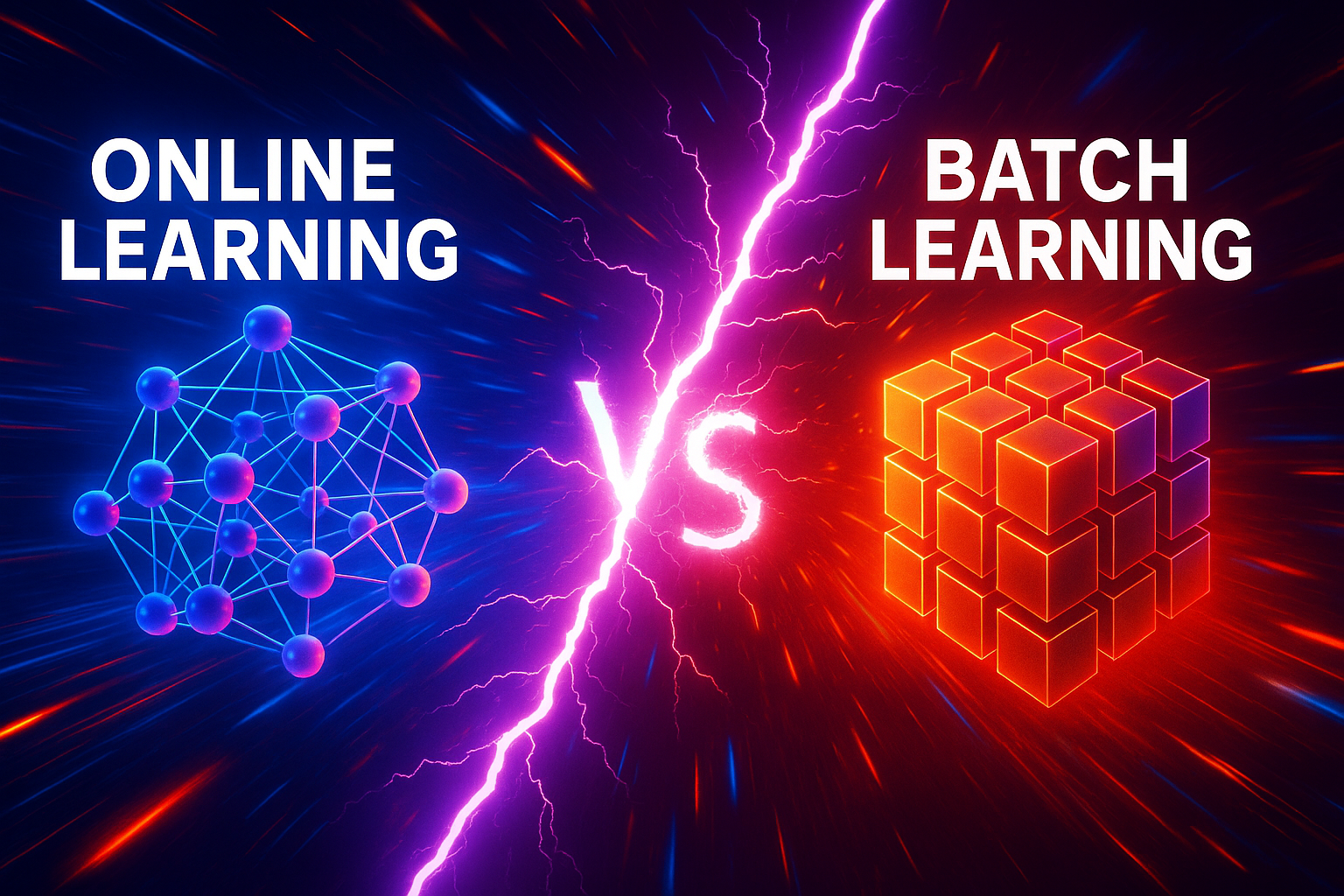
How Learning Algorithms Breathe: A Structural Divide
The difference between online and batch learning in machine learning isn’t just about how often the model updates. It’s something deeper—something structural. It’s about how an algorithm “breathes”, how it understands the world, and how it reacts to change. Batch learning takes in a huge gulp of data all at once, optimizing the model in one go. It’s like holding your breath and diving deep: powerful, but infrequent. Every time it learns, it processes the full dataset again—computationally expensive, yes, but generally consistent in predictive performance.
Online learning, on the other hand, inhales rapidly and shallowly. With each new piece of data, it adjusts the model just a little—never stopping, always moving.
This difference plays out not just in tempo, but in memory and responsiveness. Batch learning tends to treat all past data equally, and once trained, the model becomes something fixed—good at reconstructing “what the world used to be”. Online learning, by contrast, is biased toward the most recent inputs. It’s better at reinterpreting “what the world is becoming right now”. And when your target environment is a fast-moving market—as with bitBuyer 0.8.1.a—that kind of immediacy isn’t just helpful. It’s necessary.
There’s also a critical difference when it comes to decentralization. Batch learning assumes data will be collected and crunched centrally, typically on a server. But bitBuyer 0.8.1.a was designed for edge-based, node-by-node intelligence. In that setting, online learning is far more natural. Each node learns locally, processes locally, and only shares results. That aligns perfectly with privacy protection, scalability—and with federated learning, which bitBuyer uses to great effect. In this architecture, online learning isn’t just an option. It’s the structurally correct choice.
For bitBuyer 0.8.1.a, structural alignment wasn’t just a nice-to-have—it was the starting point of its entire strategic logic. Batch learning, with its centralized update cycles, clashes with the decentralized, open-source nature of bitBuyer’s architecture. Online learning wasn’t chosen because it was “technically better”. It was chosen because, given what bitBuyer is and what it stands for, no other path made sense. It may look like a tech decision—but in truth, it was a structural necessity.
Is Adaptability Really a Trade-Off with Accuracy?
Online learning is often framed as the approach that “adapts well but lacks precision”. But that narrative is more superficial than it seems—and context can flip the equation entirely. In domains with stable data distributions and fixed targets—like image recognition or voice processing—batch learning often wins out in terms of accuracy. That’s because training and deployment environments closely resemble one another. But in bitBuyer 0.8.1.a’s world—where markets swing constantly and targets change by the hour—“learning the past well” doesn’t necessarily translate into “predicting the future accurately”.
Here’s the real question: Accuracy for whom? In an architecture like bitBuyer 0.8.1.a, where every node optimizes its own strategy, what’s valuable is user-level experiential accuracy. It’s not about a centralized model delivering a one-size-fits-all solution; it’s about each node arriving at predictions that work for its own context. That’s where online learning excels—by catching shifts in local conditions and adjusting without being anchored to a node’s own historical biases.
Moreover, bitBuyer 0.8.1.a is designed to manage what’s often cited as online learning’s Achilles heel: unstable precision. It achieves this through rigorous model synchronization and filtering. Nodes that produce outliers or show signs of overfitting are excluded from the network’s shared strategies. In their place, only validated, reliable outputs circulate. This results in a new performance axis—precision with adaptability—and breaks free from the outdated binary of trade-off thinking. bitBuyer doesn’t chase the “average right answer from the past”. It seeks the best possible move in the now.
Ultimately, bitBuyer 0.8.1.a aims to resolve a classic OSS paradox: delivering real-time profits in short-term markets while preserving the openness, extensibility, and generality that define sustainable open-source systems. That means it can’t prioritize accuracy at the cost of speed—or vice versa. It needs both. And online learning, in bitBuyer’s case, isn’t a compromise. It’s the only viable bridge between the two. In this architecture, adaptability and accuracy are no longer at odds—they’re redefined as mutually necessary for survival.
The Limits of Real-Time—and the Philosophy That Meets Them
Online learning isn’t magic. Its strengths in responsiveness come with real trade-offs—namely, dependence on computational resources and the risk of instantly spreading poor learning across the system. That’s why bitBuyer 0.8.1.a is being designed with safeguards like flagging and filtering out nodes that report abnormally high ROI. In a distributed learning environment, even a single rogue node can degrade the entire ecosystem. Preventing that kind of systemic contamination is critical.
Another challenge: online learning is highly sensitive to data order. A few unlucky losses in a row can distort a model’s trajectory. That’s why bitBuyer 0.8.1.a adopts strategies like once-daily synchronization and federated averaging—methods that strike a balance between freshness and stability. The system doesn’t need to make instant decisions all the time—it just needs to stay current enough. That balance is what allows it to transcend the usual limits of real-time learning.
bitBuyer 0.8.1.a embraces these difficulties head-on. Its design makes users co-creators of an evolving AI through ongoing learning. But this isn’t just a technical architecture—it’s a continuation of bitBuyer’s core philosophy: making OSS sustainable. By relying on no central servers and leaning into community-driven evolution, the platform turns the vulnerabilities of online learning into strengths through decentralization. And that’s not just a design decision—it’s the clearest sign that bitBuyer 0.8.1.a is built with the long-term future of OSS in mind.
In this light, bitBuyer’s real-time architecture isn’t just about speed. It’s a foundation for reconciling two seemingly opposing forces: user-driven evolution and reliable profit generation. Every micro-update feeds back into a system that operates smoothly and profitably, in ways static strategies can’t replicate. That’s why online learning isn’t just a technology at the heart of bitBuyer—it’s a philosophy. And choosing it wasn’t a technical option—it was a principled necessity.

